“To what purpose, April, do you return again?”
—Edna St. Vincent Millay
Who owns you?
I got a chance to sit down with John Stossel to talk about the concept of self-ownership. Who owns me? I do!—and what are the implications, cultural, economic, and political, of that revolutionary idea? Check it out:
Economic liberty in the Arizona Supreme Court
In that interview, I suggested that Arizona is one of the freest states, especially when it comes to economic liberty. Well, the Arizona Supreme Court is now considering an important case that will determine either economic freedom—the right to earn a living—is a “fundamental” right under the Arizona Constitution. I talked about that case with Jeff Orvitz.
Court strikes down “prevailing wage” laws
And I was on Chris DeSimone’s Wake Up show to talk about the Goldwater Institute’s legal victory against Phoenix’s and Tucson’s prevailing wage ordinances.
Life on Mars
My friends at The Dispatch asked me to write about what it’s like living in Phoenix. I answered, as I always do: it’s like living on Mars.
Excerpt:
Arizona is Mars. Specifically, it’s the Mars from Ray Bradbury’s short stories. It’s got canals, weird plant life, ancient and mysterious abandoned cities, and at times the same bittersweet, nostalgic optimism that any reader of The Martian Chronicles would immediately recognize. In real life, Bradbury was inspired by Venice, California. But anyone who grew up in Los Angeles County and moved to Phoenix, as I did, can testify that the Valley of the Sun has Venice beat when it comes to otherworldly magic.
Wielding the pen
I spoke at this year’s Federalist Society National Student Symposium about writing. I only had about a half an hour, so I couldn’t get into too much detail in my advice, but I did my best to offer a few tidbits on improving one’s writing skills:
Upcoming talks
I have a lot of speaking events coming up, and I hope you’ll be able to join me!
First, I’ll be speaking in Austin tomorrow about the Declaration of Independence, and specifically on its status as law, at an event cosponsored by the Civitas Institute and the Pacific Legal Foundation.
On April 8, I’ll also be speaking at the Sacramento Federalist Society about my upcoming book on the Declaration.
On April 9, I’ll be speaking at the Phoenix Federalist Society about the recent Supreme Court decision about tariffs.
April 13, I’ll be speaking at the University of Wyoming Federalist Society about my Declaration of Independence book.
April 14, I’ll be at the University of Denver to talk about the Privileges of Immunities Clause of the Fourteenth Amendment.
April 17, I’ll be in Miami, to talk about my Declaration of Independence book at an event sponsored by the National Review Institute.
April 18, I’ll be speaking to the Cato Institute’s Sphere project about the Declaration of Independence. That’s here in Phoenix.
And then May 1 is our official launch date for the book, at the Cato Institute in Washington, D.C.
What is “the rule of law,” anyway?
My friends at the Society for the Rule of Law recently asked me to offer my thoughts on that question. You can read them here. Excerpt:
The “rule of law” is actually a very simple idea. It rests in the recognition that not everything the ruler says is law. Whereas a dictator’s every word is automatically deemed to be law (hence the term’s origin in the Latin “dicere,” meaning “to say”), the concept of the rule of law begins with the proposition that some things a ruler says are the law, and some things he says are not. Like a tiny seed growing into an enormous tree, this seemingly simple observation is the source of everything we know as our constitutional order.
If some things the ruler says are law and some things are not, then there must be some way to tell the difference. And that means it must be possible to debate whether or not something the ruler has said qualifies as law. That debate, in turn, can become highly complicated, involving questions of precedent, tradition, logic, and ritual; this is the realm of the lawyer, who brings various arguments to bear to help sort out what the law itself actually is.
“Vanilla”
I have a new poem in the latest issue of The Lyric.
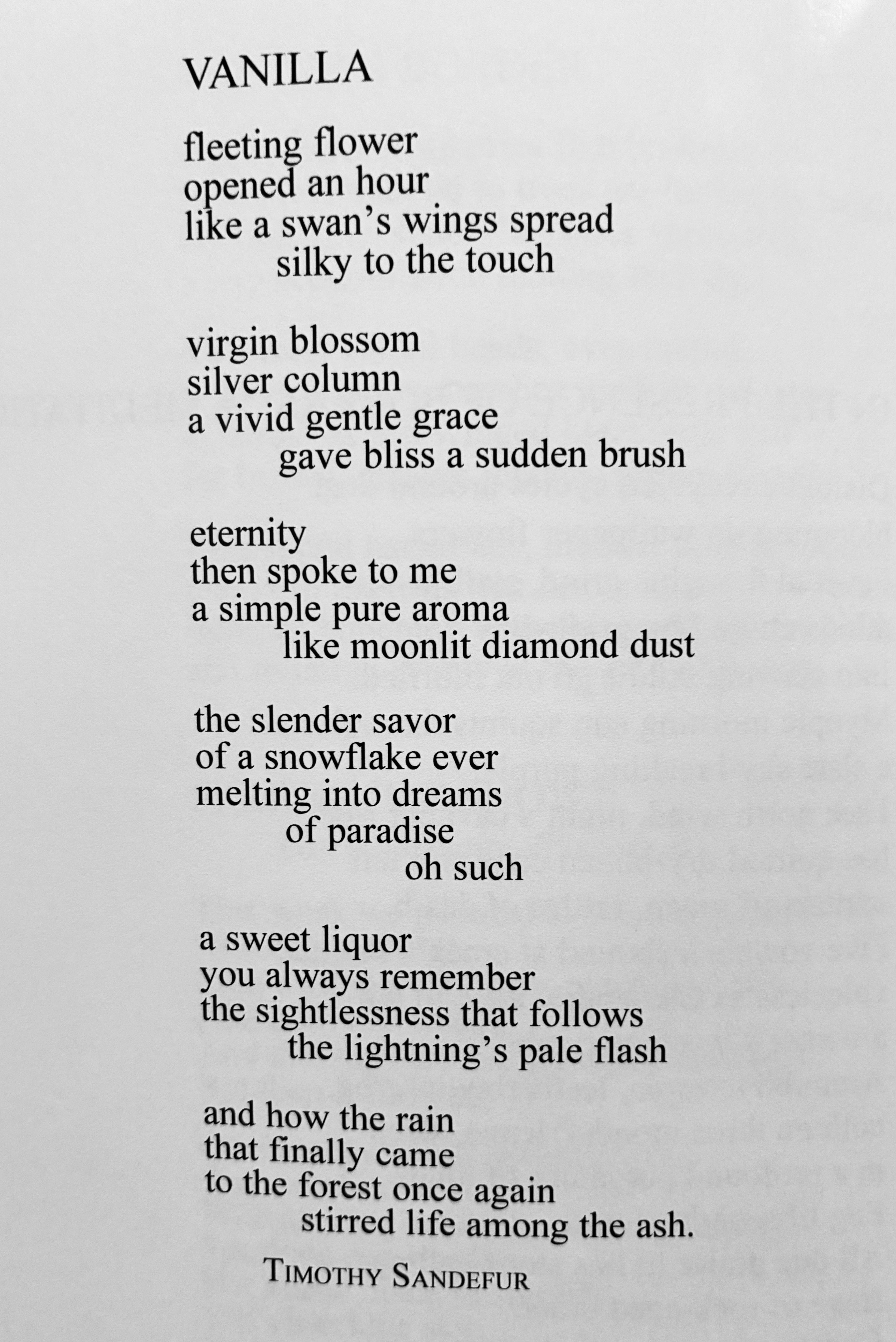
This poem was in part inspired by a tour I took some years ago of the only vanilla farm in the United States, which is located on the Big Island of Hawaii. It is a painstaking task to raise vanilla, as every individual blossom of the orchid lily must be hand-fertilized with a paint brush during a brief hours-long window on the one day when the flower blooms. If you’re ever on the leeward side, I very much recommend a visit to the Hawaiian Vanilla Company.